
Naomi
Osaka
Four Grand Slams. A serve that breaks 120 mph. And a willingness to put mental health above everything — redefining what it means to be an elite champion.
Athlete Bio & Grand Slams
Born in Osaka, Japan, and raised in the United States, Naomi Osaka became the first Japanese player — male or female — to hold the top ranking in the world. Her power-baseline game and flat, penetrating serve have made her one of the most feared players on the hard court. Osaka's four Grand Slam titles arrived in rapid succession, confirming she's not just a generational talent but a true champion architect.
Beyond her racket, Osaka has changed the conversation around athlete mental health, stepping away from competition at the peak of her powers to protect her wellbeing — and returning stronger. She's a case study in modern elite performance: physical, mental, and emotional layers working as one system. Compare her holistic approach to Serena Williams' mental conditioning framework to see two generations of champions who redefined the sport.
Baseline Power Training
Osaka's forehand and backhand are engineered for pace — not just rally depth but rally-ending power. Her training team structures off-court strength work specifically to amplify rotational force through the kinetic chain: hip, core, shoulder, wrist. This mirrors the philosophy laid out in our research behind the reps section — strength training must be specific to the demands of the sport.
Medicine Ball Rotations
Explosive side-to-side throws against a wall or to a partner, generating hip-led rotational power that directly transfers to the groundstroke swing path.
Cable Woodchops
Low-to-high and high-to-low cable pulls targeting the obliques and transverse abdominis — the engine room of every forehand swing.
Romanian Deadlift
Heavy RDLs build the posterior chain power Osaka loads during her wide forehand reaches, protecting the lower back while maximising force output.
Band-Resisted Split Squats
Lateral-band resistance challenges the hip abductors during the lunge position — mimicking the open-stance forehand loading pattern.
Cross-Body Pallof Press
Anti-rotation isometrics train the core to resist, then release force — the foundation of consistent flat-ball striking at high speed.
Baseline Rally Blocks
On-court 20-ball rally sequences targeting placement accuracy at full swing speed — never sacrificing pace for position, never position for pace.
"Power without placement is just noise. Osaka trains both simultaneously."
Train Like A Baller AnalysisServe Speed & Mechanics
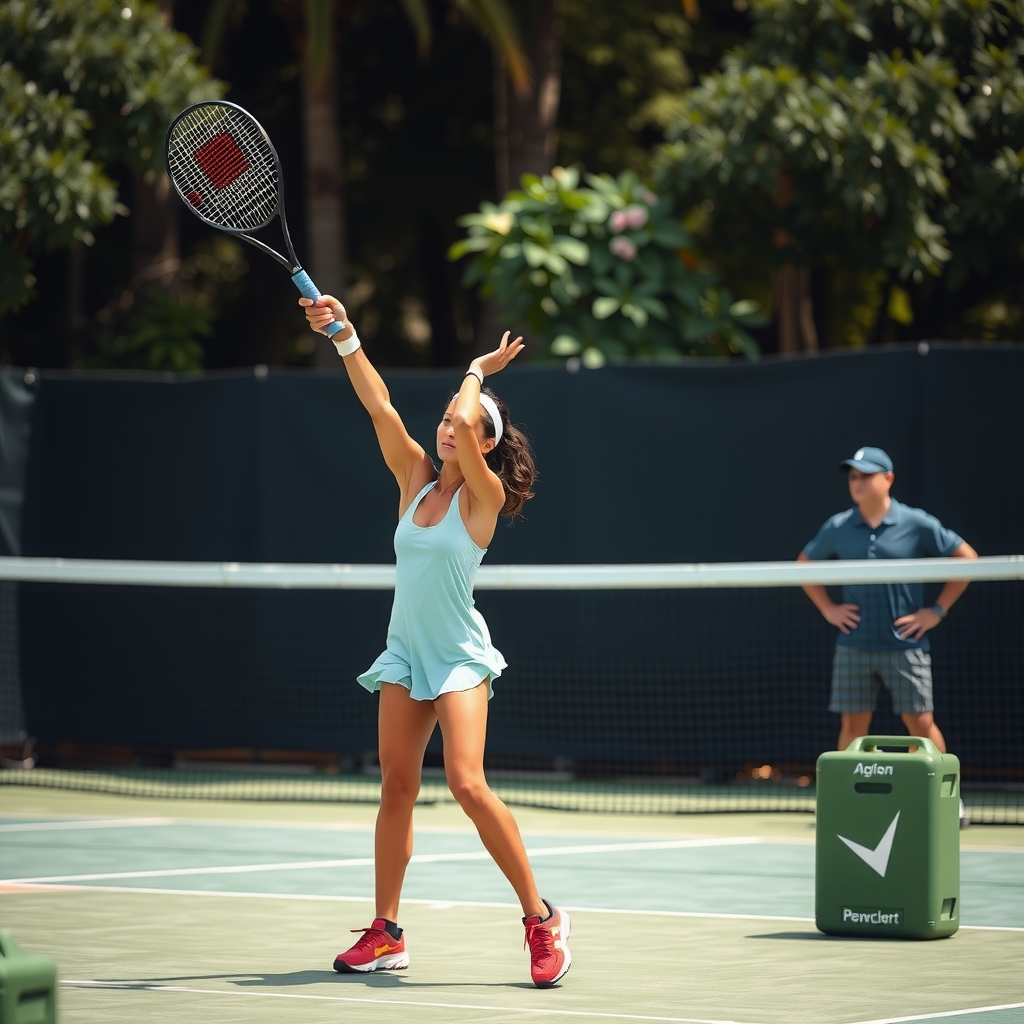
At 6 feet tall with exceptional shoulder mobility, Osaka possesses one of the most mechanically sound serves in women's tennis. Her service motion uses a full shoulder-over-shoulder rotation, leg drive from deep knee bend, and a delayed racket drop that generates elite racket head speed.
Her training includes isolated shoulder strengthening — rotator cuff work, serratus anterior activation, and thoracic extension drills — alongside serve-specific explosive power development. This parallels the serve training principles discussed in our Serena Williams serve mechanics breakdown.
Court Fitness & Agility

Osaka's playing style demands explosive lateral movement, rapid first-step acceleration, and the ability to recover court position after striking aggressive winners. Her conditioning programme blends court-specific sprints with structured gym work to build the energy system profile tennis demands: repeated short-burst, high-power outputs across two to three hours.
For a deep dive into how energy systems differ across sports and why tennis demands a unique protocol, see our Sports Hub energy systems guide.
Spider Drill
5-cone court sprint pattern targeting multi-directional acceleration, deceleration, and rapid change of direction under fatigue.
Lateral Hurdle Hops
Mini-hurdle lateral series building the fast-twitch fibre recruitment needed for explosive wide-court recovery steps.
Sled Push Intervals
Loaded sled pushes across 15m develop horizontal force application — the same mechanics used in explosive first-step acceleration to wide balls.
Mental Health & Advocacy
In 2021, Osaka withdrew from the French Open citing mental health concerns, igniting a worldwide conversation about athlete wellbeing that had been whispered about for decades. Her candour wasn't a sign of weakness — it was a master class in self-awareness and long-term thinking. The science backs her: chronically elevated cortisol, sleep disruption, and anxiety directly impair athletic performance. Managing mental health IS performance management.
This echoes the principles explored in our 6th gear mental performance section and the mindset work discussed on the Simone Biles training philosophy page.
Boundary Setting
Osaka publicly declined press conferences to protect her mental state — modelling the principle that elite performance requires guarding psychological resources, not just physical ones.
Authentic Communication
Rather than masking struggle, Osaka speaks openly about anxiety and depression, normalising help-seeking for a generation of athletes who previously suffered in silence.
Advocacy Into Action
Osaka co-founded a mental health fund for athletes, translating personal experience into systemic change — a reminder that champion impact extends far beyond the court.
Identity Beyond Sport
By refusing to define herself solely through tennis results, Osaka builds the psychological resilience needed to return from setbacks without her identity collapsing around a loss.
Recovery & Mindfulness

Osaka treats recovery as a non-negotiable pillar of performance — not a luxury or a sign of under-training. Her recovery stack integrates physical restoration with deliberate mental decompression, because in a sport demanding split-second decision-making under pressure, a fatigued nervous system is as damaging as a fatigued muscle.
The role of sleep in her programme is especially critical — for more on why elite athletes prioritise it, see our sleep is your secret weapon guide on the homepage.
- 9 hours of sleep targeted per night — non-negotiable in tournament weeks.
- Ice bath followed by contrast shower post-match to accelerate tissue recovery.
- Daily mindfulness or meditation practice — 10 to 20 minutes minimum.
- Social media boundaries — deliberate digital detox windows to reduce cognitive load.
- Music as ritual — curated playlists used before matches to control arousal and focus states.
- Anti-inflammatory nutrition — omega-3 rich foods, colourful vegetables, and hydration monitoring woven through every day.
Train Like A Champion
Osaka's greatness isn't accidental — it's engineered. Baseline power, a precision serve, elite conditioning, and the courage to prioritise mental health. Build your own blueprint using the same principles.