
400m Hurdles · World Record Holder
Sydney
McLaughlin-
Levrone
Athlete Profile
Bio & World Records
Sydney McLaughlin-Levrone is not just the fastest 400m hurdler in history — she is an entirely new category of athlete. Born in New Jersey in 1999, she arrived at the sport with a blend of raw sprinting ability, technical precision, and a spiritual grounding that sets her apart even among elites. At age 16, she became the first high-school woman to break 53 seconds in the 400m hurdles. Since turning professional, she has rewritten the record book seven times, each barrier once thought impossible.
Under the guidance of coach Bob Kersee — the same architect behind Florence Griffith Joyner's legendary performances — Sydney refined a stride pattern, hurdle clearance technique, and championship-level race strategy that has left rivals scrambling to keep pace. Her 2023 World Championships performance and her Paris 2024 gold medal cemented a legacy that extends well beyond athletics.
Record Timeline
The Foundation
Hurdle Training Philosophy
Sydney and Bob Kersee operate from a core belief: hurdles are not obstacles — they are transition points between sprint segments. Training is built around eliminating any psychological or mechanical hesitation at the barriers. Every rep in practice is designed to make the 10 hurdles feel inevitable, automatic, frictionless.
Sprint capacity is the engine. Sydney trains flat 400m speed aggressively — hurdles only slow you if your sprint base is underdeveloped. Kersee programs flat sprint work year-round.
Lead-leg snap, trail-leg mechanics, and attack angle are drilled at sub-maximal intensities until they become muscle memory. Video review after every session is non-negotiable.
World records are built on stride efficiency. Sydney runs 13 strides between hurdles 1–7, transitioning to 14 strides late. Each shift is trained so it feels effortless under fatigue.
On The Track
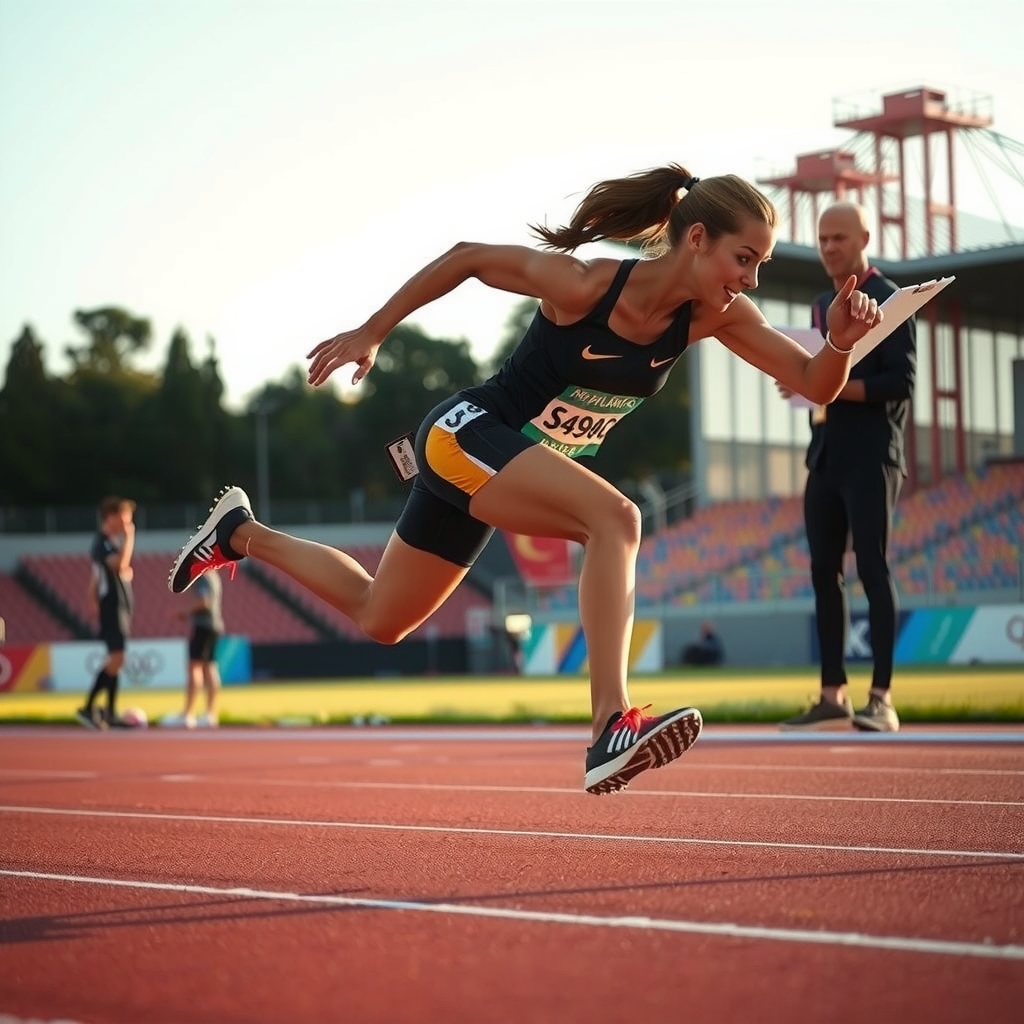
Sprint Mechanics & Track Work
Block Acceleration Drills
5–6 × 30m block starts at 95–100% intensity. Focus on drive phase mechanics — shin angle, arm drive, and heel cycling — before adding hurdles to the equation. See how Usain Bolt's block protocol influenced modern sprint methodology.
Flying 60s & Speed Endurance
2–3 × 60m flying sprints develop top-end speed. Speed endurance is built through 3–4 × 200m at near-maximal pace with extended recovery — maintaining mechanical quality even when the lactic acid peaks.
Hurdle Clearance Repeats
3 hurdles only, repeated 8–12 times. Pure mechanics work: lead-leg snap height, trail-leg horizontal pull, shoulder parallel to the bar. Low clearance = less deceleration = faster splits.
Full Race Runs at 85–90%
2 × full 400mH at controlled intensity. The purpose is pattern installation: rhythm, stride count, and the mental map of every hurdle. Racing at 100% happens in competition only. Check how pros structure their training weeks for more on periodization principles.
In The Gym
Strength & Power Training

Sydney's gym work is sprint-specific — every movement translates directly to power output on the track. Explosive lower-body strength determines how much force she can apply into the ground per stride. Core stability determines her hurdle clearance efficiency. Nothing is in the program for aesthetics alone.
| Movement | Sets × Reps | Purpose |
|---|---|---|
| Power Clean | 4 × 3 | Triple extension / ground force |
| Back Squat | 4 × 5 | Posterior chain strength |
| Single-Leg RDL | 3 × 8 | Hip stability & hamstring load |
| Trap Bar Jump | 4 × 4 | Explosive rate of force |
| Nordic Curl | 3 × 6 | Hamstring injury prevention |
| Hip Thrust | 3 × 10 | Glute drive & sprint propulsion |
| Pallof Press | 3 × 12 | Rotational core stability |
Off-season volume is higher (5 days/week lifting); in-season drops to 2–3 sessions to prioritize track quality. Compare this to Serena Williams' strength philosophy for cross-sport strength programming insights.
The Inner Game
Faith, Mindset & Recovery
"I don't run for a world record. I run because I've been called to run — and that takes all the pressure off."
— Sydney McLaughlin-LevroneSydney's Christian faith is not a sidebar to her athletic career — it is the axis around which everything rotates. Pre-race rituals include prayer and Scripture, not as superstition, but as a genuine anchor that releases her from outcome anxiety. When the stakes are highest, she describes herself as experiencing an unusual calm.
Her mindset approach mirrors what sports psychologists call process orientation — she competes to express her training, not to protect a record. This psychological posture allows full aggression in execution without the performance-inhibiting fear of failure. For more on mental conditioning, see The 6th Gear: Your Mind.
Recovery pillars: 9+ hours of sleep nightly, targeted soft tissue work (ART and massage 3×/week), contrast therapy post-hard sessions, anti-inflammatory nutrition, and deliberate deload weeks every 4th week of the training block.

The Blueprint
Race Strategy Breakdown
A 400m hurdle world record is not an accident — it is the execution of a precisely rehearsed game plan. Here is how Sydney runs 50.68 seconds:
Block Start & Drive Phase
Aggressive first stride with 8 steps to hurdle 1. No hesitation. Controlled acceleration, not a flat-out sprint — the curve dictates rhythm.
Aggressive Split & 13-Stride Rhythm
Maintain 13 strides between hurdles. Speed is at or near maximum. Lead leg attacks, trail leg snaps. The first 200m split is run at controlled aggression — not survival pace.
The Crucial Middle
This is where world records are won or lost. Sydney maintains form when others begin to labor. The 13-stride pattern holds. Relaxation in the upper body is deliberate — tension kills speed.
Transition to 14 Strides
Fatigue forces a stride shift. The 14-stride pattern is rehearsed hundreds of times so the shift is automatic. No panic. Maintain forward lean and arm drive — the finish is 45m after the final barrier.
Drive Through The Line
Final 40m is pure sprint. Hip extension, arm pump. Lean at the tape. The world record is set before she sees the clock — she runs the process, not the time.
For more on elite sprint strategy, see Usain Bolt's race physics breakdown and explore how movement patterns differ across sports.
Train Like
The Record Breaker
Sydney's dominance is built on relentless repetition, technical obsession, and a mindset that runs on faith — not fear. Every hurdler, every sprinter, every athlete has something to learn from this playbook.